
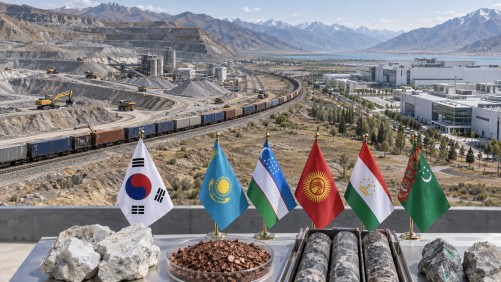
As global demand for critical minerals intensifies, South Korea is enhancing its collaboration with Central Asian nations to secure these essential resources. The recent South Korea–Central Asia summit in Seoul underscored this strategic alliance, resulting in over 70 agreements and memorandums aimed at fostering cooperation in various sectors, particularly critical minerals. This development is part of a broader effort by both parties to strengthen industrial ties and boost economic growth in the region.
The summit marked the inauguration of a C5+1 forum for industry ministers, establishing a platform for regular dialogue. South Korea is keen to leverage Central Asia’s rich mineral resources to support its automotive, electronics, battery, and energy industries. In return, Central Asian countries are eager to develop local processing capabilities, moving beyond merely exporting raw materials. This mutual interest sets the stage for a comprehensive collaboration encompassing the entire mineral supply chain, from exploration to the production of high-value goods.
Uzbekistan, a key player in the region, has proposed creating an investment alliance focused on critical minerals, alongside developing clusters for exploration, mining, and production. Meanwhile, Kazakhstan has signaled readiness to cooperate in areas such as rare metals, nuclear and clean energy, and artificial intelligence. This extends to strengthening its strategic partnership with South Korea. Kyrgyzstan and Tajikistan are also looking to tap into Korean expertise, particularly in the mining of antimony and tungsten.
South Korea’s initiatives in Central Asia are part of a larger geopolitical context where major powers like China, the United States, the European Union, and Japan are also vying for access to the region’s mineral wealth. Central Asian governments are increasingly focused on attracting investments that can lead to the establishment of local processing facilities and industrial production, rather than continuing the export of unprocessed raw materials.
Beyond minerals, South Korea is expanding its influence through involvement in transport and infrastructure projects across Central Asia. These efforts are set to continue, with the next South Korea–Central Asia summit scheduled for Kazakhstan in 2028, promising to further cement these growing economic ties.